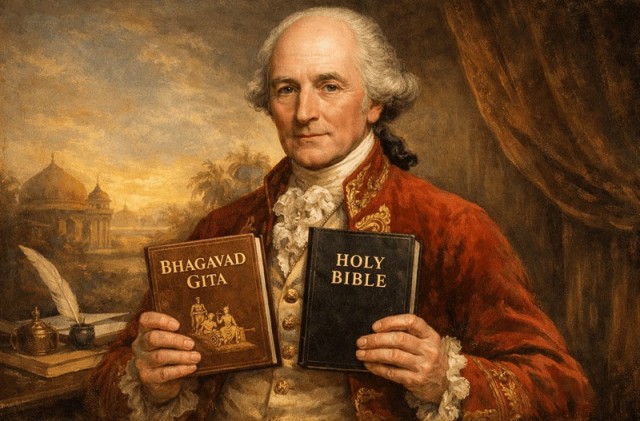
Long before Indian mystics and monks spoke of the Krishna-Christ connection, a British Governor-General discerned their theological kinship—and quietly altered the West's understanding of the Bhagavad Gita, says OSWALD PEREIRA
It is one of history's quieter ironies that the first sustained attempt to draw a theological bridge between Krishna and Christ did not come from an Indian saint or a Vedantic sage, but from a colonial administrator.
Long before Sri Ramakrishna (1836–1886) spoke of the harmony of religions, and decades before Swami Sri Yukteswar Giri (1855–1936) interpreted Christ through yogic cosmology, it was Warren Hastings (1732–1818)—the first Governor-General of the British East India Company—who publicly articulated a profound parallel between the Bhagavad Gita and the Bible. Hastings was born 104 years before Ramakrishna and 123 years before Yukteswar, yet he arrived at a conclusion that later spiritual giants would echo with far greater authority.
Hastings' engagement with India was not merely administrative; it was intellectual, even reverential. Unlike many of his contemporaries who viewed Indian civilisation as a curiosity—or worse, a superstition—Hastings approached it as a philosophical equal. His fascination with the Bhagavad Gita was deep enough to prompt a decisive act: commissioning its first English translation.
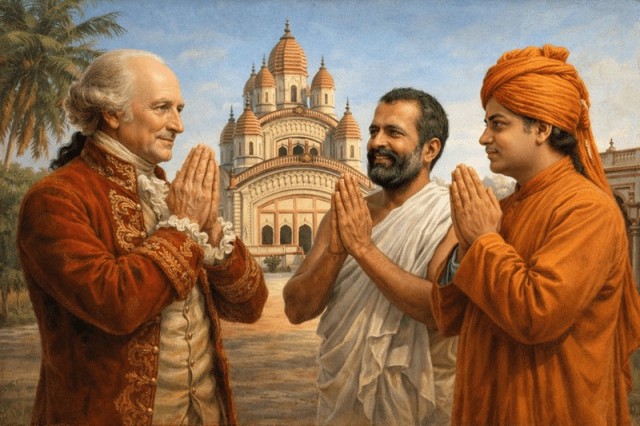
Imaginary image of Warren Hastings, Sri Ramakrishna and Swami Vivekananda greeting each other with Namastes, standing outside the Dakshineswar Kali Temple
That task fell on Sir Charles Wilkins, a gifted linguist and printer in the service of the East India Company, who arrived in India in 1770. The result was the 1785 publication in London by C Nourse of Bhagavat-Geetâ, or Dialogues of Kreeshna and Arjoon. Remarkably, this was no underground Orientalist indulgence. The work carried an introduction by Hastings himself and bore the formal sanction of the Company's directors—an extraordinary endorsement for a Hindu scripture at the height of the British empire.
In that introduction, Hastings, writing on the Gita, suggested that among all the religions known to humankind, this Hindu scripture most closely corresponded, in theological accuracy, with Christianity itself. As Charles Johnston, a distinguished Irish-born scholar, translator, and Theosophist, best known for introducing Indian philosophy and Sanskrit texts to the English-speaking world, observed in a 1930 article in The Atlantic, Hastings believed the Gita "most powerfully illustrated the fundamental doctrines of Christianity." It was a bold statement, especially coming from the highest colonial authority in India.
Wilkins, too, was no casual translator. He believed the Gita was composed to encourage a refined monotheistic—or what he termed "unitarian"—vision within Hinduism, one that rose above ritual polytheism and pointed towards a single, supreme divine reality. Whether or not one agrees with Wilkins' reading, it is undeniable that he approached the text not as an exotic artefact, but as a serious theological document capable of conversing with Western religious thought.
This rare convergence of administrative power and spiritual curiosity has not gone unnoticed by later scholars. Swami Tathagatananda, writing in December 2020, noted that Wilkins "loved the Bhagavad Gita wholeheartedly," while Hastings held it in "fascination and great esteem." In his learned preface, Hastings praised not only the Gita's literary brilliance but also its ethical universality, asserting that the sincere practice of its teachings would lead humanity toward peace and bliss.

Most prophetic of all was Hastings' quiet aside—one that history has treated with a certain poetic justice. He wrote that the philosophers of India would endure long after British dominion had faded into memory. The British Empire, Hastings seemed to understand, was temporary; wisdom was not.
By the nineteenth century, as Professor Richard H Davis notes in Bhagavad Gita: A Biography, the text had acquired the sobriquet "the Hindu Bible." Yet Davis is careful to add that, like all great scriptures, the Gita resists simplification. Its internal richness allows it to speak different truths to different audiences—warriors and monks, renunciates and householders, nationalists and mystics alike.
What Hastings glimpsed, then, was not just a simple equivalence between Krishna and Christ, but a deeper resonance: a shared moral seriousness, a theology of action tempered by love, and a vision of the divine that transcends sectarian boundaries. That such insight should come from a colonial governor is both heartening and instructive.
Perhaps it reminds us that ideas often travel strange routes—and that spiritual bridges are sometimes built not by saints alone, but by unlikely witnesses standing at the crossroads of history.
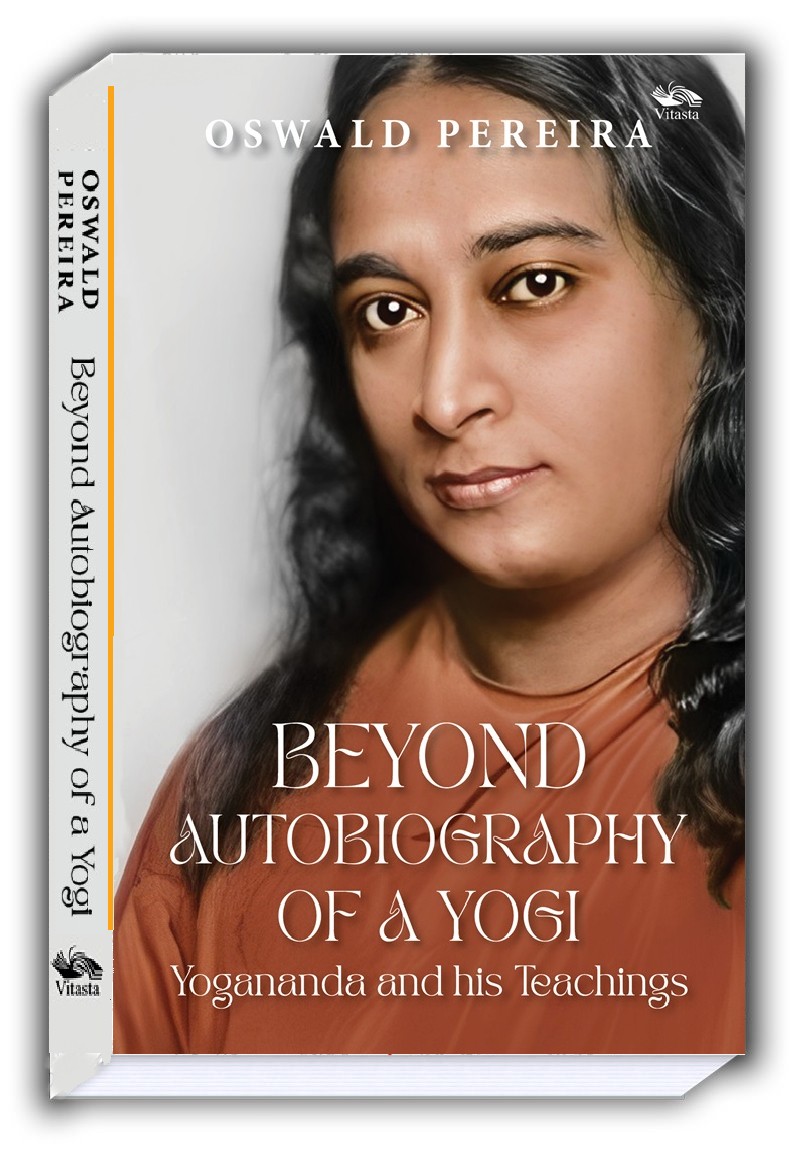
Note: This article has been adapted from my book, Beyond Autobiography of a Yogi, published by Vitasta Publishing.
Order your copy of the book on
Amazon India: https://www.amazon.in/dp/8119670582
Amazon USA: https://rb.gy/np8ai1
Oswald Pereira, a senior journalist, has written ten books, including Beyond Autobiography of a Yogi, The Newsroom Mafia, Chaddi Buddies, The Krishna-Christ Connexion, How to Create Miracles in Our Daily Life and Crime Patrol: The Most Thrilling Stories. Oswald is a disciple of Paramhansa Yogananda, and practises Kriya Yoga.
Featured Image: Imaginary pic of Warren Hastings holding the Bhagavad Gita and the Bible