
The approaches or paths to Christian and Eastern meditation may be different, but the goal is the same—to commune with God, says OSWALD PEREIRA. They are like two sides of the same coin
With World Meditation Day just gone by on Sunday, December 21, it is most timely to set the record straight on Christian meditation. It is true that meditation is not a priority in Christianity and among 'practising' Christians. But it is also a fact that 'Christian meditation' is as real as what the great yogis of India practise.
During the Middle Ages, the monastic traditions of both Western and Eastern Christianity moved beyond vocal prayer to Christian meditation.
Teachings in both the Eastern and Western Christian churches have emphasised the use of Christian meditation as an element in increasing one's knowledge of Christ. In Western Christian teachings, meditation is described as the inherent action of the Holy Spirit to help the meditating Christian understand the deeper meanings of the Word of God.

People of different faiths meditating together in harmony
Christian meditation is the process of deliberately focusing on specific thoughts (such as a Bible passage) and reflecting on their meaning in the context of the love of God. In Christian meditation, a structured attempt is made to become aware of and reflect upon the revelations of God.
The Catholic Church encourages meditation as a form of prayer. The Church says: "Meditation is above all a quest. The mind seeks to understand the why and how of the Christian life, in order to adhere and respond to what the Lord is asking."
Pope Francis, the 266th pontiff of the Catholic Church, who passed away on April 21, 2025, at the age of 88, had said, "meditation is a need for everyone."
At a weekly audience in April 2021, he said, "We all need to meditate, to reflect, to find ourselves."
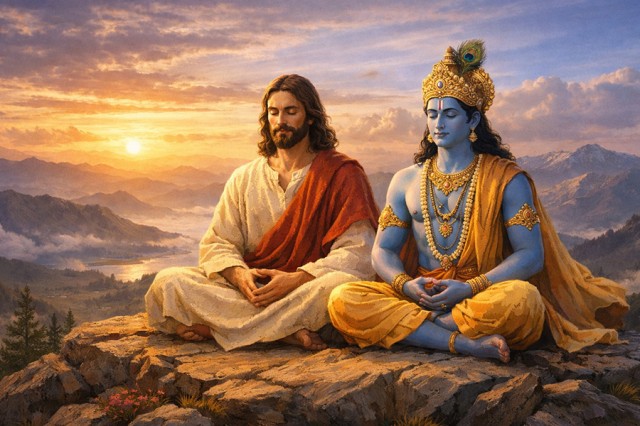
Imaginary image of Krishna and Christ meditating together on a mountain top
He added, "Especially in the voracious Western world, people seek meditation because it represents a high barrier against the daily stress and emptiness that is everywhere."
Pope Francis stated that "The prayer of the Christian is first of all an encounter with the Other, with a capital "O": the transcendent encounter with God….That is, meditating means going―guided by a phrase from the Scripture, from a word―to the encounter with Jesus within us….And in this way, only in this way, can we find ourselves."
The word meditation comes from the Latin word meditārī, which has a range of meanings including to reflect on, to study, and to practice.
In the Old Testament, there are two Hebrew words for meditation: hāgâ, which means to sigh or murmur, but also to meditate, and sîḥâ, which means to muse, or rehearse in one's mind. The Bible mentions meditate or meditation 23 times, 19 times in the Book of Psalms alone.
A number of saints and historical figures have presented specific approaches to Christian meditation.

The Spiritual Exercises of St. Ignatius of Loyola (1491–1556), the founder of the Jesuits, contain numerous meditative exercises. To this day, the Spiritual Exercises remain an integral part of the Novitiate training period of the Roman Catholic religious order of Jesuits.
The exercises often involve imagery in which one enters a biblical scene. For example, the practitioner is encouraged to visualise and meditate upon scenes from the life of Christ, at times asking questions from Christ on the cross, during crucifixion.
Saint Francis de Sales (1576–1622) used a four-part approach to Christian meditation based on preparation, consideration, affections and resolutions and conclusions.
Saint Padre Pio stated: "Through the study of books one seeks God; by meditation one finds him." Saint Thomas Aquinas (1225–1274) said that meditation is necessary for devotion, and the Second Vatican Council called for "faithful meditation on God's word" as part of the spiritual formation of seminarians.
Saint John of the Cross (1542–1591), viewed Christian meditation as a necessary step toward union with God, and wrote that even the most spiritually advanced persons always needed to regularly return to meditation.
Christian meditation is generally held to be distinct from the practice of meditation in Eastern religions. While other types of meditation may suggest approaches to disengage the mind, Christian meditation aims to fill the mind with thoughts related to biblical passages or Christian devotions.
Although some mystics in both the Western and Eastern churches have associated feelings of ecstasy with meditation (e.g. St. Teresa of Avila's legendary meditative ecstasy), St. Gregory of Sinai, stated that the goal of Christian meditation is "seeking guidance from the Holy Spirit, beyond the minor phenomenon of ecstasy."
The search for wisdom, not ecstasy, marks the path of Christian meditation, according to Theologian E P Clowney—a wisdom sought in the "Christ of Scripture and the Scripture of Christ."
Even if the practice of Christian meditation is distinct from that in Eastern religions, the fact remains that importance is given to meditation in both Christianity and Eastern religions.
The approaches or paths to Christian and Eastern meditation may be different, but the goal is the same—to commune with God.
Note: This article has been adapted from my book, Beyond Autobiography of a Yogi, published by Vitasta Publishing.
Order your copy of the book on
Amazon India: https://www.amazon.in/dp/8119670582
Amazon USA: https://www.amazon.com/Beyond-Autobiography-Yogi-Yogananda-Teachings/dp/8119670582/
Oswald Pereira, a senior journalist, has written ten books, including Beyond Autobiography of a Yogi, The Newsroom Mafia, Chaddi Buddies, The Krishna-Christ Connexion, How to Create Miracles in Our Daily Life and Crime Patrol: The Most Thrilling Stories. Oswald is a disciple of Paramhansa Yogananda, and practises Kriya Yoga.